Private Practice Marketing that Pays for Itself
Updated January 2026
Summary
Calculate your marketing ROI before investing - Use your practice's actual annual revenue, patient lifetime value, and growth goals to see exactly how many new patients you need for video marketing to break even.
Track marketing results to actual patient appointments - Measure which videos prospects watch before booking, how long they engage with your content, and which specific touchpoints convert website visitors into scheduled patients.
HIPAA-compliant healthcare marketing specialists - Work with video producers who understand medical practice compliance requirements, proper patient consent protocols, and healthcare-specific regulations... not generic marketing agencies.
Honest healthcare marketing advice without sales pressure - Find partners who'll tell you when you're not ready for video marketing, when your current strategy is working, or when you should invest elsewhere... even when honesty costs them business.
Flexible contracts for private practices - Choose 3-month or 6-month commitments instead of locked-in annual contracts. If video marketing isn't increasing patient bookings within six months, you should be able to exit without penalties.
Hiring a Marketing Agency Isn’t Easy
I'm going to tell you something most marketing agencies won’t.
If you can't track whether your marketing investment is working, you shouldn't do it.
Yup. I said it.
Private practice doctors didn't build successful practices by making bets they couldn't measure. You run numbers on everything… staffing, equipment, supplies, overhead. Why would marketing be any different?
It shouldn't be.
And it doesn't have to be.
But first, you need to pick a type of private practice marketing that A) works and B) you can track.
Why Video? (The Data You Actually Need)
Before we talk numbers, let's address the obvious question.
Why video specifically?
Because your patients are already watching. The question is whether they're watching you or your competition.
The patient behavior research is clear:
77% of people look for visual content before picking a provider (Aha Media Group)
78% of people prefer learning about a product or service by watching video (Wyzowl)
83% of people would like to see more videos from brands (Wyzowl)
Think about that first statistic. Three-quarters of potential patients are researching you online before they ever call.
They want to see and hear from you before they choose you.
In other words, they’re looking for reasons to trust you.
So, what are they finding when they search for your practice? Does what they find inspire trust?
Here's what video actually does:
Increases understanding by 74% (Wyzowl) - Patients grasp complex medical information faster when they can see and hear you explain it
2x more likely to be shared (Brightcove) - Patients share video content twice as often as any other format, expanding your reach organically
Increases landing page conversions by over 80% (Unbounce) - The right video on the right page turns more visitors into booked appointments
This isn't about being trendy.
It's about meeting patients where they already are… researching healthcare providers online, preferring video content, and making decisions based on what they can see and hear before they ever pick up the phone or click your online calendar.
Not good enough?
Try this.
Look around at the big health systems in your area. Look at the most successful systems in the country:
Their websites
Their social media posts
Their email campaigns
All of them feature video.
Healthcare organizations that devote millions of dollars to marketing… invest in video.
They are telling you what’s successful for them.
Think video could work for private practices? Me too.
The Real Math Behind Video Marketing
Let's run your actual numbers… not some hypothetical case study from a practice nothing like yours.
We built an ROI calculator specifically for private practice doctors because every practice is different. A dermatology practice in suburban Atlanta has completely different economics than an orthopedic practice in rural Wisconsin.
Start With What You Know
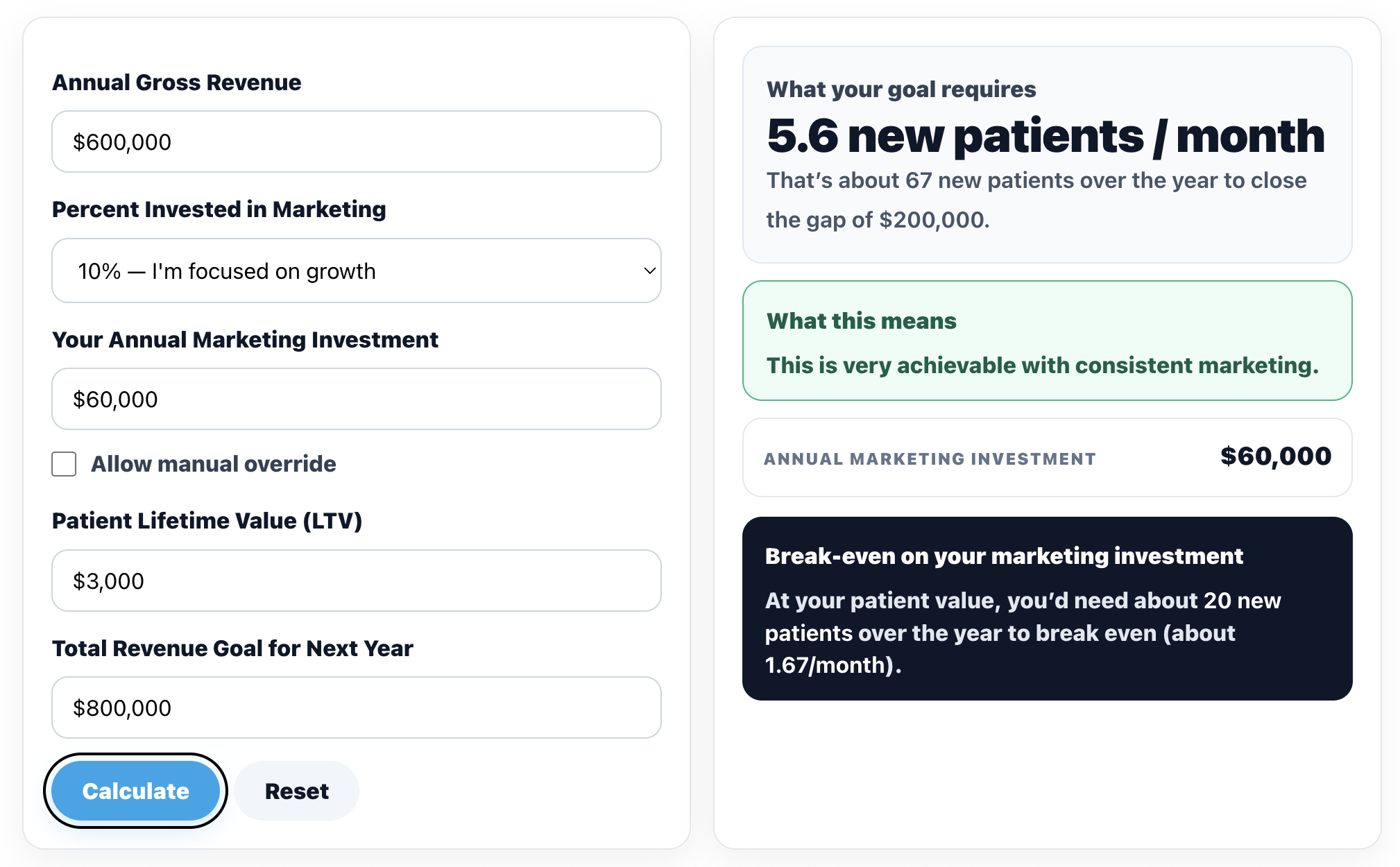
Your current annual revenue: Let's say you're doing $600,000 annually. (Plug in your real number… this only works if you're honest with yourself.)
Your growth goal: Maybe you want to hit $800,000 next year. That's $200,000 in new revenue you need to generate.
Your patient lifetime value: If your average patient is worth $3,000 over their lifetime with your practice, you need approximately 67 new patients to hit that goal.
That breaks down to 5.6 new patients per month.
The Marketing Investment Question
Here's where it gets interesting.
If you're currently investing 10% of revenue in marketing (the standard for growth in the healthcare industry), that's $60,000 annually… or about $5,000/month.
Now ask yourself: what are you getting for that $5,000?
Generic digital ads that look like everyone else's?
SEO work that might pay off in 6-12 months?
A website refresh that doesn't truly explain who you are?
Social posts that get 4 likes from your staff's personal accounts?
Or could you invest that same money in a video system that:
Works 24/7 explaining your practice to prospects
Builds trust before they ever call
Answers their questions without tying up your front desk
Helps the right patients choose you (and the wrong ones self-select out)
In other words, a system that actually inspires people to book an appointment.
The Break-Even Reality
Here's what most agencies won't show you upfront:
With your $60,000 annual marketing investment and a $3,000 patient lifetime value:
You need just 20 new patients over the year to break even.
That's 1.67 patients per month.
Think about that for a second. If your video system helps convert just two additional patients per month who were researching you online, you're profitable.
Everything beyond that second patient? That's growth.
To hit your $800,000 goal, you need 5.6 new patients per month.
Your marketing is already budgeted. The question is which approach gives you the best shot at those 5.6 patients?
Try Your Own Numbers
We built a calculator so you can see exactly what this looks like for your practice:
Use the Private Practice ROI Calculator
Plug in:
Your actual annual revenue
Your current marketing investment percentage
Your patient lifetime value
Your revenue goal for next year
The calculator will show you exactly how many new patients you need… and what that means for your marketing ROI.
No tricks. No inflated assumptions. Just math.
Why Most Healthcare Marketing Feels Like a Black Box
You know what drives me crazy?
Agencies that say "trust the process" but can't show you the process working.
Doctors are trained diagnosticians. You don't tell a patient "trust me, you're getting better" when the labs tell a different story. You show them the data. You explain what's happening and why.
Your marketing should work the same way.
Your marketing agency should set up tracking from day one. When it comes to video:
Which videos patients watch before calling
How long they engage with content
Where they drop off in your funnel
Exactly which touchpoints led to booked appointments
Not "brand awareness." Not "engagement metrics." Actual patients in your schedule.
The Healthcare Difference (And Why It Matters)
Here's something I learned after 20 years producing healthcare videos: healthcare practices operate under completely different rules than other businesses.
You can't:
Make claims you can't substantiate
Show patient faces without consent
Ignore HIPAA in how you store and handle information
Most video companies either don't know this or don't care.
They'll shoot testimonials that violate consent protocols.
They'll suggest marketing approaches that put you at compliance risk.
They'll treat your practice like a coffee shop or manufacturing facility.
That’s why hiring healthcare specialists makes so much sense.
Look who I’m talking to… if any industry understands the importance of hiring specialists, it’s healthcare. You’re probably one yourself.
It’s no different when it comes to marketing and video.
The Exit Strategy You Need (But Hope You Never Use)
Let's address the elephant in the room: what if this doesn't work for you?
It happens.
Sometimes because your agency has dropped the ball.
Sometimes… let’s be honest… you or your team didn’t live up to your side of the bargain.
Regardless, if video marketing isn't delivering measurable results in your practice within three to six months, you shouldn't be spending money on it.
Period.
I’ll give it to you straight. The longer the runway you’re willing to give it, the more likely it is to succeed.
This isn’t a quick fix, “We guarantee you 30 NEW PATIENTS a month!”
Video marketing should be about consistent, sustained growth.
However, if you’re feeling uneasy about the approach, find an agency that’s willing to allow you to dip your toe in.
For example, we offer 3-month, 6-month, and 12-month options for our clients… just sayin’.
What "Safe" Actually Looks Like
You didn't ask for marketing to be part of your job description. You went to medical or dental school to help people, not to become a content creator.
But here's the reality… patients are researching doctors online before they ever pick up the phone or click to book an appointment. If they can't get a sense of who you are, how you practice, and whether you're the right fit… they’re choosing someone else.
Video solves this without requiring you to become a marketer.
You read that right. You don’t need to become a marketer.
If you do it right, your “marketing” looks and feels a lot like you’re delivering an amazing patient experience… not “selling” people.
When you employ a video marketing system:
Your agency handles production: You show up, we capture your expertise
Your agency ensures compliance: HIPAA-compliant processes, documented consent
Your agency tracks results: Real numbers, real patients, real ROI
You stay focused: on patient care, not marketing
The system runs in the background.
Patients watch your videos.
The right ones book appointments.
You see the numbers monthly. If it works, you continue. If it doesn't, your agency should tweak the strategy.
That's it.
No complexity. No gimmicks. No marketing speak.
The Trust Question
I get it. You’ve probably been burned before.
Agencies that overpromised.
Consultants who didn't understand healthcare.
Marketing expenses that disappeared into thin air with nothing to show for it.
You can change that. You need to find a potential marketing partner who wants to understand your current patient acquisition process and tell you honestly whether video will help… or if you should spend your money somewhere else.
We do free marketing strategy evaluations with private practice owners all the time. Sometimes we tell practices they're not ready for video yet. Sometimes we say their current approach is working fine and they shouldn't change it.
Why would we do that?
Because trust isn't built on landing every deal. It's built on telling the truth, even when it costs us business, and we’re not the only ones.
That’s the kind of partner you’re looking for.
What Happens Next
The practices seeing the best ROI from video aren't the ones with the biggest budgets.
They're the ones who treat video like any other clinical tool… measure results, adjust based on data, keep what works.
I know you want some sort of assurance that your marketing is going to work. And there are plenty of marketers willing to give you a guarantee.
However, the best marketers will give you the truth.
There are no guarantees.
Don’t get dazzled by a bevy of marketing stats. There’s only two metrics that matter for you.
Is our schedule filling up, yes or no?
Are we generating more revenue, yes or no?
That’s it.
If you’re answering yes, your marketing is working.
In my experience, video delivered consistently over time will deliver that answer.