CASE STUDY: 124 Leads, 17 New Patients, and What the Gap Between Those Numbers Actually Means
Not a health system.
Not a practice with a marketing department.
A podiatrist in private practice who wanted to attract more of the right patients… and was willing to try something different to do it.
That's the whole story.
But how it happened is worth understanding.
The Doctor
Dr. Paul Betschart runs Advanced Foot and Ankle Center in Danbury, CT.
Private practice.
The kind of doctor who got into medicine because he genuinely likes helping people, not because he had a plan to build a marketing funnel.
When we started working together, he had a clear picture of where his practice was and where he wanted it to be.
He also had a specific kind of patient in mind.
Heel pain patients.
That's his sweet spot… the thing he's particularly good at, the thing he genuinely enjoys treating.
He knew people in his area were searching for answers. They just weren't finding him.
That's not a quality problem. It's a visibility problem… and we had a plan for that.
What Most Practices Do Instead
Before getting into what we built, it's worth naming what most practices do… because it's the thing that wasn't working for Dr. Betschart before we started working together, and it's probably familiar.
Most practice marketing starts with the practice.
New equipment announcements.
Service lists.
Generic "we care about our patients" messaging.
The occasional photo of the front desk staff on a holiday.
None of that is wrong, exactly. It's just not what a patient is looking for when they're trying to decide whether to trust a doctor they've never met.
A patient with heel pain when they get out of bed at 6:00 a.m. isn’t looking for a list of services.
They're not interested in the new digital X-ray machine.
They want to know if this doctor understands what they're going through and whether they can actually help.
Most practices never answer that question. They make marketing content about themselves and hope the right people find it.
We started somewhere else.
The Strategy
Here's how the four months actually broke down.
Month 1: Strategy. Before we picked up a camera, we spent time with one specific person.
Not a demographic.
Not "adults 35 to 65 in the greater area."
One person… a heel pain patient who was already searching, already frustrated, already wondering why every morning felt like walking on glass.
What were they Googling? What were they afraid of? What would make them stop scrolling and actually pay attention?
We mapped it out.
What came back wasn't complicated… it was just specific.
Month 2: Content. We shot all the video on-site in a single day. Dr. Betschart's About Us video… him talking the way he talks to patients every day, no script, no teleprompter.
And four short reels, each one built around a question that heel pain patient was already asking.
Four questions. Four videos.
Each one built around what that specific patient was already thinking, not around what the practice wanted to say.
Month 3: Organic Distribution. The About Us video went live on the website. The reels started going out on social.
No paid spend yet… just organic posting.
There wasn’t much traction, but it was meaningful.
People were stopping. Engaging. The content was landing with the right audience.
That told us something important before we ever spent a dollar on ads: these videos were on target.
Month 4: Paid Amplification. With the website ready and the content validated, we turned on the Meta ads.
Facebook and Instagram. $30 a day.
The reels that had already proven themselves organically now had paid reach behind them.
And anyone who saw an ad and got curious landed on a website that was already ready for them… with Dr. Betschart's About Us video right there to close the trust gap.
The ads created the first touch. The website closed the trust gap. That's the sequence.
It’s the same process we run across any specialty:
identify the ideal patient
ask the questions they’re asking
answer them through video.
The questions change specialty to specialty. The framework doesn't.
The Results
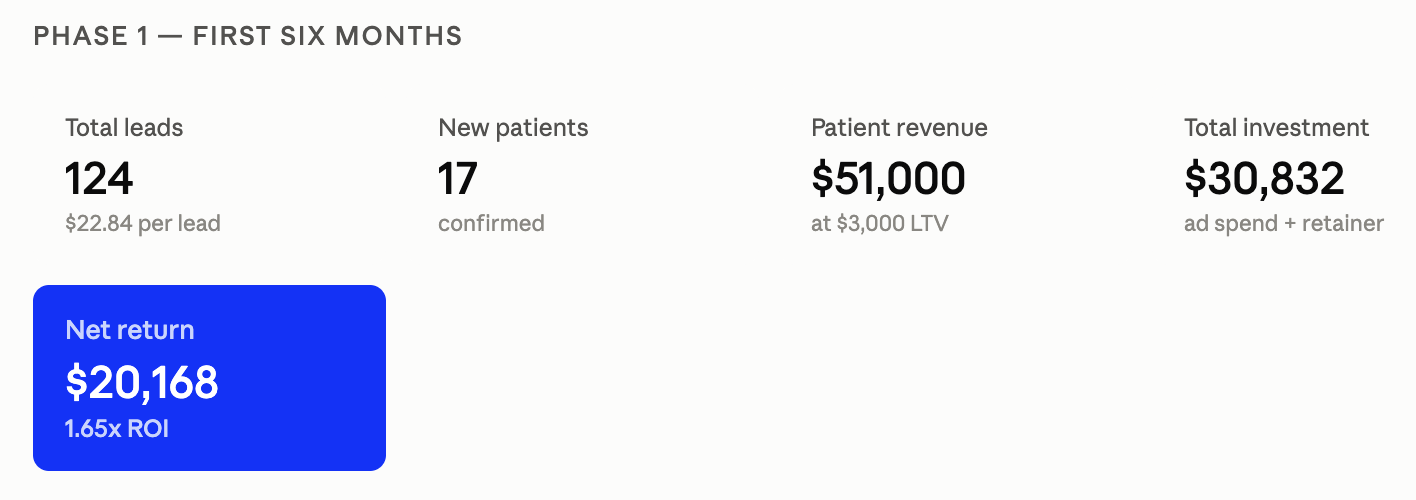
The campaign ran for 95 days and produced 124 leads at a blended cost of $22.84 per lead. Total ad spend: $2,832.
For context… healthcare lead generation on Meta typically runs $25–$60 per lead. This campaign came in below the low end of that range.
In the first three days alone, at $30 a day, the campaign generated 10 leads.
17 became confirmed new patients.
The campaign reached 11,000 unique people.
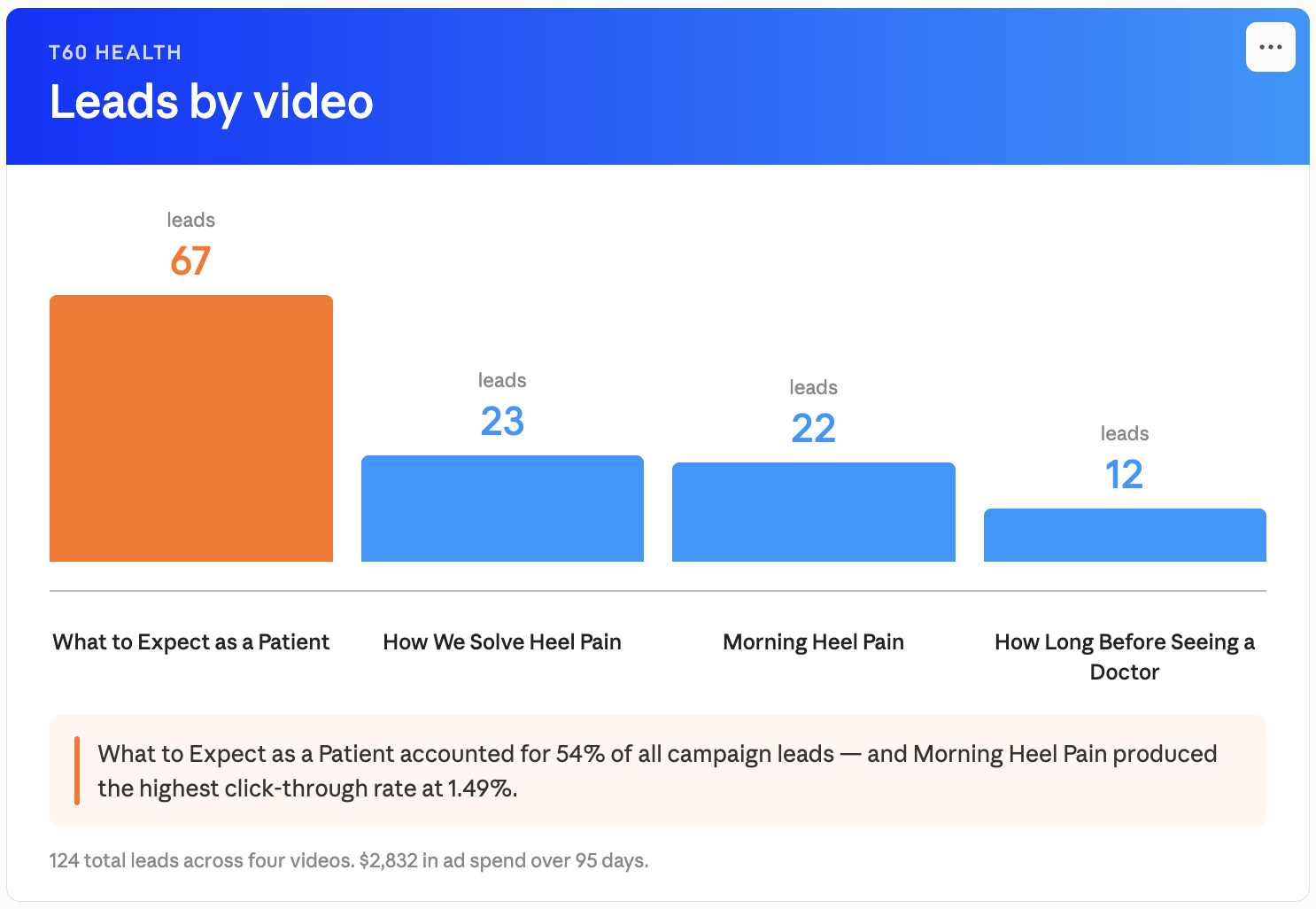
Now that we know morning heel pain is such a popular topic, we’ll produce more videos on that subject moving forward.
How the four videos performed:
Not all four ads performed equally… and the difference is worth understanding.
The strongest hook was "Morning Heel Pain." It produced the highest click-through rate in the set at 1.49%. Cold traffic. Consistent volume throughout the campaign. The reason it worked is simple: it opened with something the patient already felt the moment they got out of bed.
The most efficient ad was "How We Solve Heel Pain." It produced the lowest cost per lead at $17.25 — 34% cheaper per lead than the campaign average. It worked because it answered a question the patient was already asking, not one we assumed they should be asking.
The weakest ad in the set tried to answer a question the patient may not have been asking yet. The pattern is consistent: meet the patient where they are before offering a path forward. The ads that opened with something the patient already felt or already wondered consistently outperformed the one that tried to educate before connecting.
One more finding worth naming:
Most Meta ad creative shows meaningful fatigue at four to six weeks. These four ads held up approximately 12 weeks before we saw significant fatigue. That's not a targeting story. That's a creative quality story. Content built around real patient questions has a longer shelf life than content built around what a practice wants to say about itself.
The follow-up gap — and why it matters:
The campaign produced 124 leads. 17 became confirmed new patients. The gap between those two numbers is not a creative problem… it's a follow-up infrastructure problem, and it's the first thing we'd address in the next phase.
Those are the numbers. They sit on their own without needing much help.
The Math
Here's where I want to be completely transparent about what this actually costs, and what it's projected to return.
Every decision in this engagement was built around one figure Dr. Betschart gave us at the start: $3,000 in lifetime value per new heel pain patient. That includes repeat visits, orthotics, and referrals… the full picture of what a patient is worth to the practice over time, not just the first appointment.
At that number, the first six months look like this.
17 confirmed new patients at $3,000 each is $51,000 in patient revenue.
Against a total investment of $30,832 (ad spend plus retainer) that's a net return of $20,168 and a 1.65x ROI from a proof-of-concept campaign that never exceeded $50 a day.
To put the ad spend in context: healthcare lead generation on Meta typically runs $25–$60 per lead. This campaign came in at $22.84… below the low end of that range.
Projected Second Six Months (Months 7–12)
This is a conservative projection. We're being deliberate about saying that.
The first six months established proof of concept. A second phase starts from a fundamentally different position… validated creative, a known audience, and two solvable problems already identified.
Two campaigns would run simultaneously: heel pain and neuropathy. Both conditions. Both patient bases. Both supported by the content library already built.
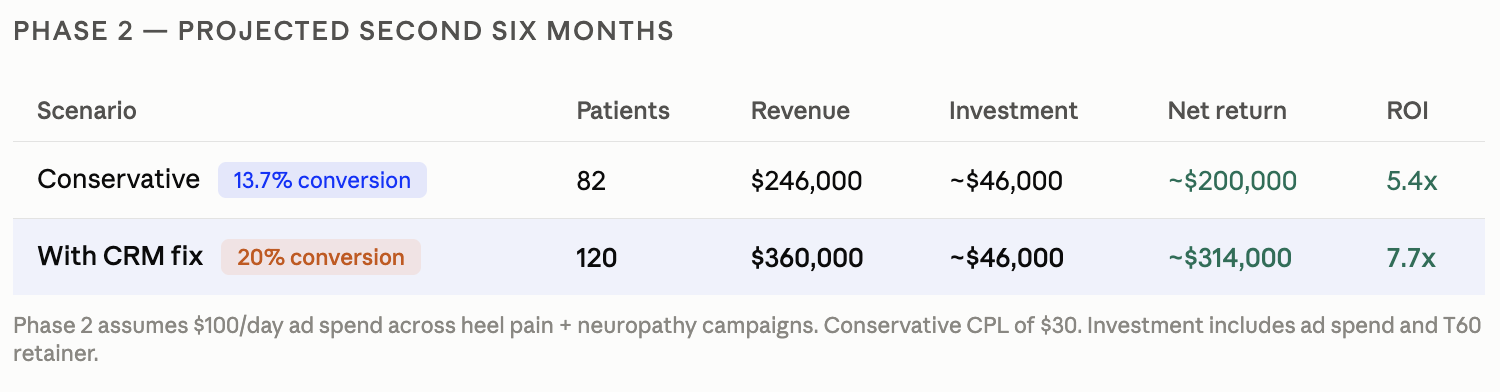
At $50 a day per campaign… $100 combined, $18,000 in ad spend over six months — and applying a conservative cost per lead of $30 to account for scaling, the math projects like this.
600 leads across both campaigns.
At the same 13.7% lead-to-appointment conversion rate as the first campaign… before the follow-up infrastructure gap is addressed… that's approximately 82 new patients.
At $3,000 each, that's $246,000 in projected patient revenue. After ad spend and retainer fees, the projected net return is approximately $200,000. A 5.4x ROI.
But the follow-up infrastructure gap is solvable.
The first campaign delivered leads manually.
The next phase connects Meta directly to the CRM… leads arrive in real time, automated follow-up begins within minutes. Industry data on speed-to-contact suggests that improvement alone could push conversion rates meaningfully higher.
A conservative bump from 13.7% to 20% produces approximately 120 new patients and $360,000 in projected patient revenue.
After ad spend and retainer fees, the projected net return climbs to approximately $314,000. That's a 7.7x ROI.
Projected Full Year
So… if we project out for an entire year, here’s what we’re looking at.
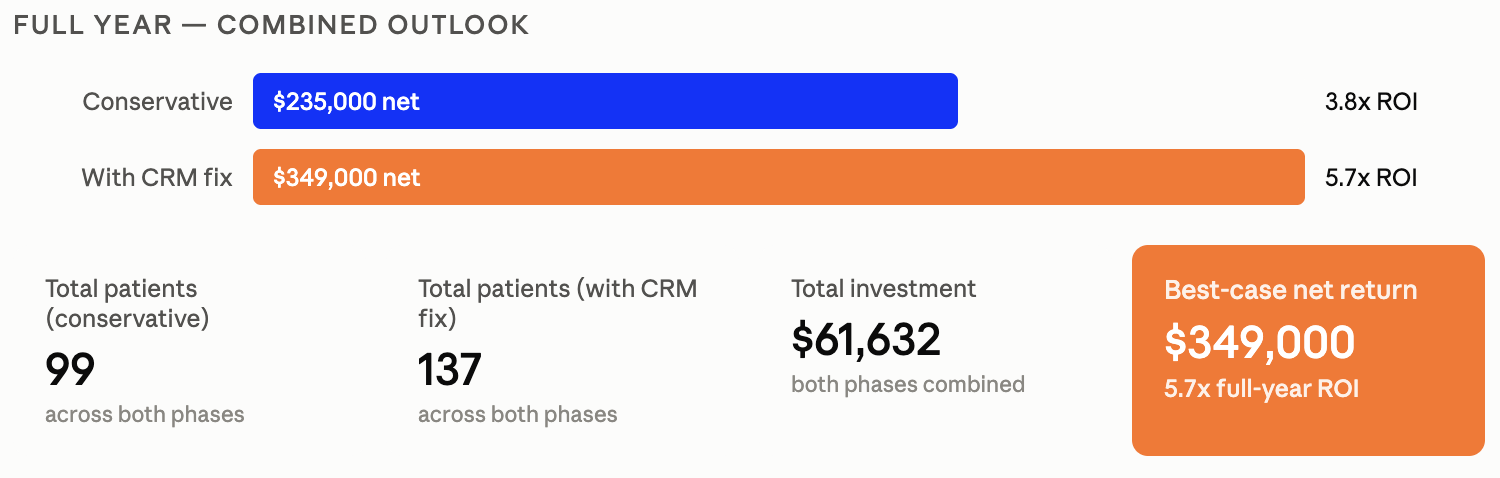
Add both phases together and here's what twelve months looks like.
At the conservative conversion rate… 17 confirmed patients in phase one, 82 projected in phase two… the full year produces approximately 99 new patients and $297,000 in total patient revenue.
Total investment across both phases: $61,632 in ad spend and retainer fees combined.
Net return: approximately $235,000.
Full-year ROI: 3.8x.
With the follow-up infrastructure fixed… pushing phase two conversion from 13.7% to 20%… the full year produces approximately 137 new patients and $411,000 in total patient revenue.
Against the same $61,632 total investment, the net return climbs to approximately $349,000.
Full-year ROI: 5.7x.
Those are conservative numbers built on a proof-of-concept campaign that never exceeded $50 a day.
The system is validated.
The creative is built.
The audience is known.
Year two starts with none of the uncertainty year one carried.
The Bigger Point
This wasn't complicated.
It wasn't expensive.
It didn't require a marketing department, an SEO audit, Google AdWords, or ZocDoc.
It was four videos built around one specific patient's real questions, put in front of that patient where they were already looking.
That's the whole idea.
Start with the patient.
Figure out what's actually going on in their head… what they're afraid of, what they're Googling, what they need to hear before they'll trust someone enough to book.
Then build content around that. Then put it in front of them.
When the content is built around a real person's real questions, it doesn't feel like an ad. It feels like an answer.
And answers are what build trust.
This works because the content was built around one real patient's real question. The same ad spend behind generic content won't produce this.
Dr. Betschart didn't reinvent his practice. He just showed up… in the right place, with the right message, for the right patient. And the right patients found him.
That's what this looks like when it works.