CASE STUDY: We Told a Podiatrist to Spend $30/Day on Ads. He Got 10 Leads in 3 Days.
Not a health system.
Not a practice with a marketing department.
A podiatrist in private practice who wanted to attract more of the right patients… and was willing to try something different to do it.
That's the whole story.
But how it happened is worth understanding.
The Doctor
Dr. Paul Betschart runs Advanced Foot and Ankle Center.
Private practice.
The kind of doctor who got into medicine because he genuinely likes helping people, not because he had a plan to build a marketing funnel.
When we started working together, he had a clear picture of where his practice was and where he wanted it to be.
He also had a specific kind of patient in mind.
Heel pain patients.
That's his sweet spot… the thing he's particularly good at, the thing he genuinely enjoys treating.
He knew people in his area were searching for answers. They just weren't finding him.
That's not a quality problem. It's a visibility problem… and we had a plan for that.
What Most Practices Do Instead
Before getting into what we built, it's worth naming what most practices do… because it's the thing that wasn't working for Dr. Betschart before we started working together, and it's probably familiar.
Most practice marketing starts with the practice.
New equipment announcements.
Service lists.
Generic "we care about our patients" messaging.
The occasional photo of the front desk staff on a holiday.
None of that is wrong, exactly. It's just not what a patient is looking for when they're trying to decide whether to trust a doctor they've never met.
A patient with heel pain when they get out of bed at 6:00 a.m. isn’t looking for a list of services.
They're not interested in the new digital X-ray machine.
They want to know if this doctor understands what they're going through and whether they can actually help.
Most practices never answer that question. They make marketing content about themselves and hope the right people find it.
We started somewhere else.
The Strategy
Here's how the four months actually broke down.
Month 1: Strategy. Before we picked up a camera, we spent time with one specific person.
Not a demographic.
Not "adults 35 to 65 in the greater area."
One person… a heel pain patient who was already searching, already frustrated, already wondering why every morning felt like walking on glass.
What were they Googling? What were they afraid of? What would make them stop scrolling and actually pay attention?
We mapped it out.
What came back wasn't complicated… it was just specific.
Month 2: Content. We shot all the video on-site in a single day. Dr. Betschart's About Us video… him talking the way he talks to patients every day, no script, no teleprompter.
And four short reels, each one built around a question that heel pain patient was already asking.
Four questions. Four videos.
Each one built around what that specific patient was already thinking, not around what the practice wanted to say.
Month 3: Organic Distribution. The About Us video went live on the website. The reels started going out on social.
No paid spend yet… just organic posting.
There wasn’t much traction, but it was meaningful.
People were stopping. Engaging. The content was landing with the right audience.
That told us something important before we ever spent a dollar on ads: these videos were on target.
Month 4: Paid Amplification. With the website ready and the content validated, we turned on the Meta ads.
Facebook and Instagram. $30 a day.
The reels that had already proven themselves organically now had paid reach behind them.
And anyone who saw an ad and got curious landed on a website that was already ready for them… with Dr. Betschart's About Us video right there to close the trust gap.
The ads created the first touch. The website closed the trust gap. That's the sequence.
It’s the same process we run across any specialty:
identify the ideal patient
ask the questions they’re asking
answer them through video.
The questions change specialty to specialty. The framework doesn't.
The Results
The campaign ran for 31 days.
31 leads total.
$623.84 in total ad spend. Roughly $20 per lead.
In the first three days alone, at $30 a day, the campaign generated 10 leads.
The best-performing video was on on Morning Heel Pain… the one about that specific feeling of the first steps out of bed.
17 leads at $16.53 each.
That video alone accounted for more than half the campaign's total leads.
The campaign reached 11,000 unique people.
Those are the numbers. They sit on their own without needing much help.
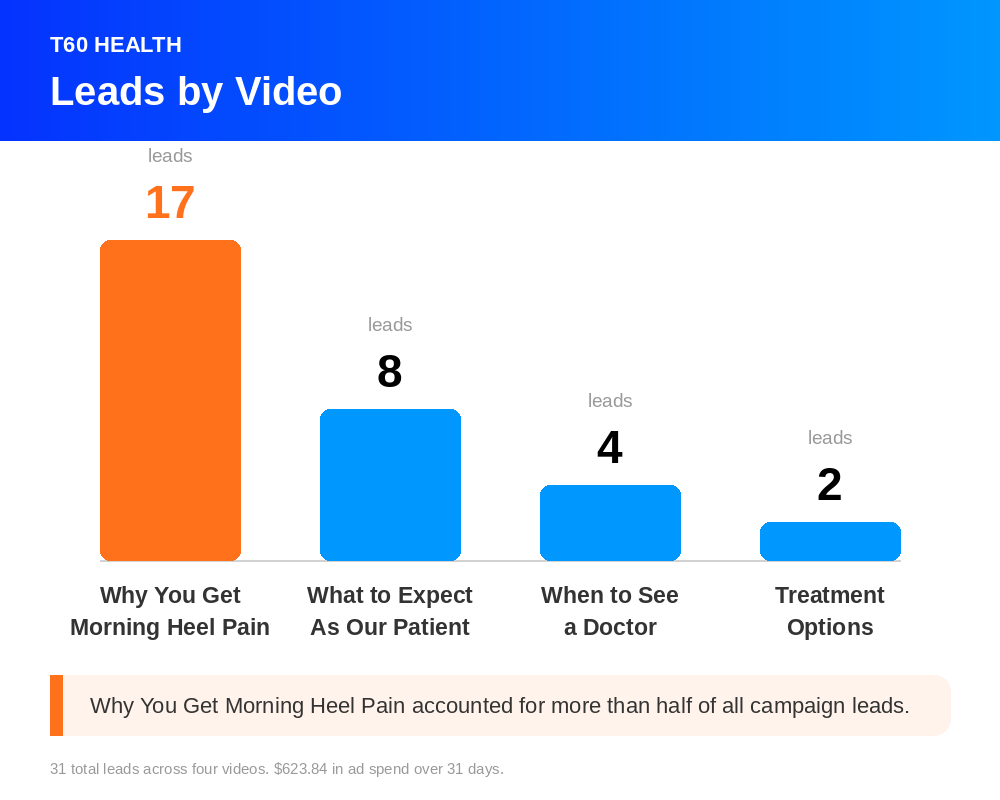
Now that we know morning heel pain is such a popular topic, we’ll produce more videos on that subject moving forward.
The Math
Here's where I want to be completely transparent about what this actually costs, and what it's projected to return.
Dr. Betschart put his own figure on what a heel pain patient is worth to his practice over time… $3,000 in lifetime value.
That's his estimate, based on his own patient history.
Not a projection. Not a best-case scenario.
The campaign generated 31 leads in 30 days at $30 a day.
Three have converted to booked patients so far… a roughly 10% conversion rate.
All projections below use that same conservative 10% and the same cost per lead of approximately $20. No rosy assumptions.
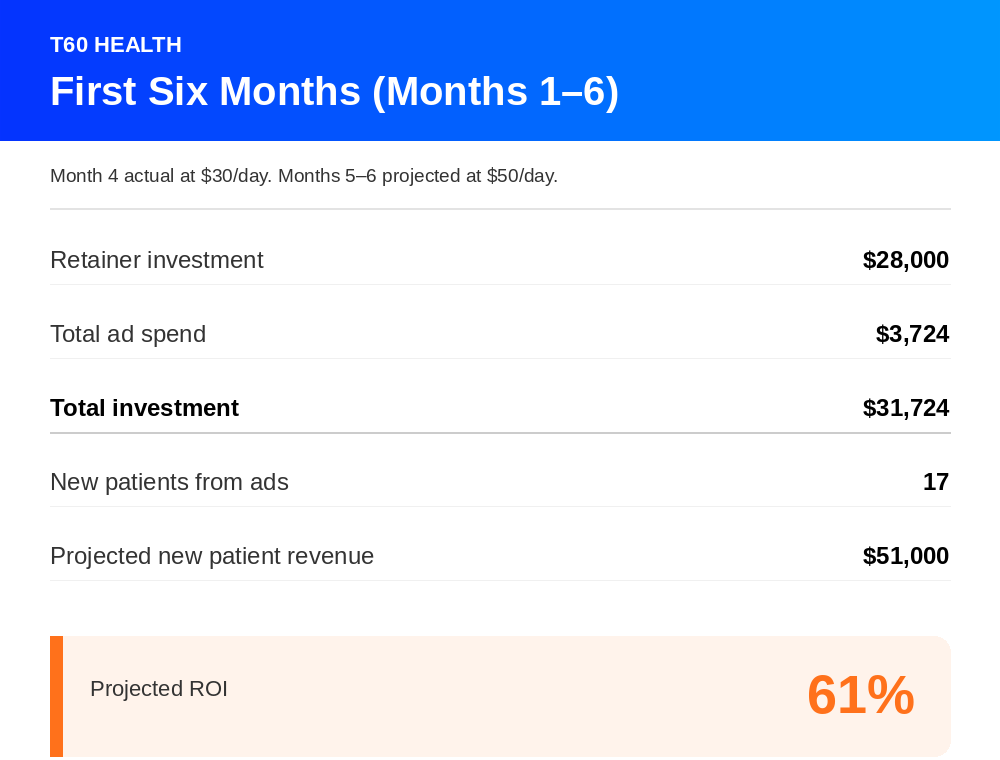
We also included the cost of our retainer to give a complete picture. That includes strategy creation, on-site video shoots, and post-production editing.
First Six Months (Months 1–6)
Month 4 is the only completed ad month at $30/day. We’re upping the ad spend in Months 5 and 6 to $50/day.
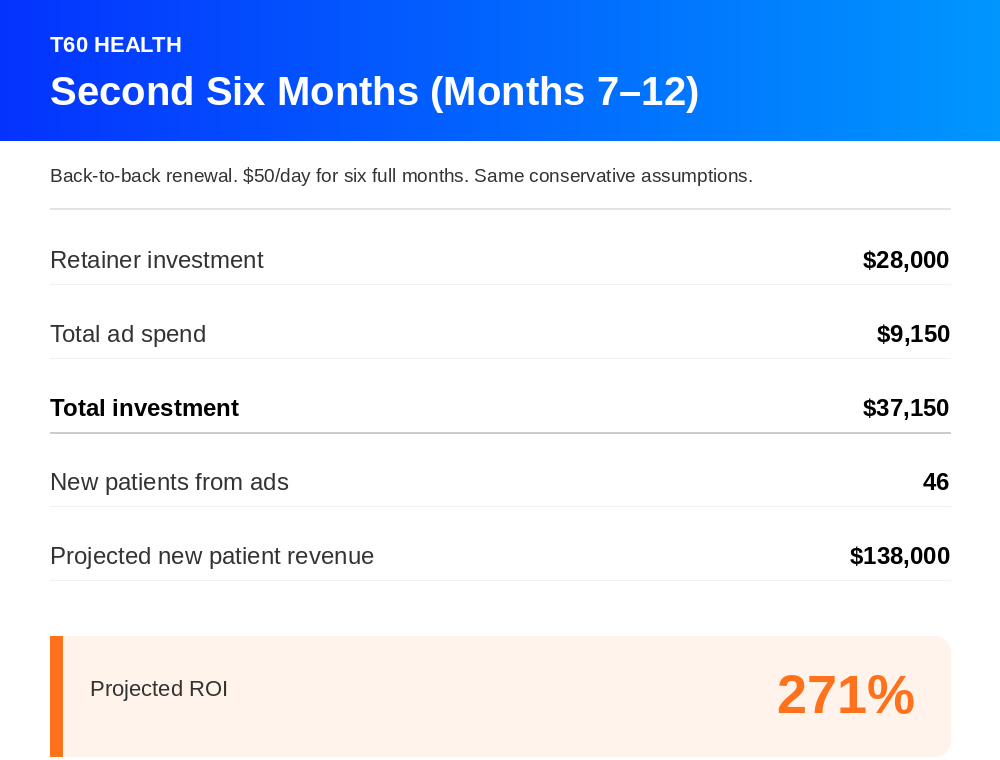
Second Six Months (Months 7–12)
The second engagement runs back-to-back with the first.. one continuous year. The content library is already built. The website is already working. The algorithm has six months of conversion data. The audience has been seeing Dr. Betschart's content for half a year.
Conservative projection: same cost per lead, same 10% conversion rate, $50/day for six full months.
So… if we project out for an entire year, here’s what we’re looking at.
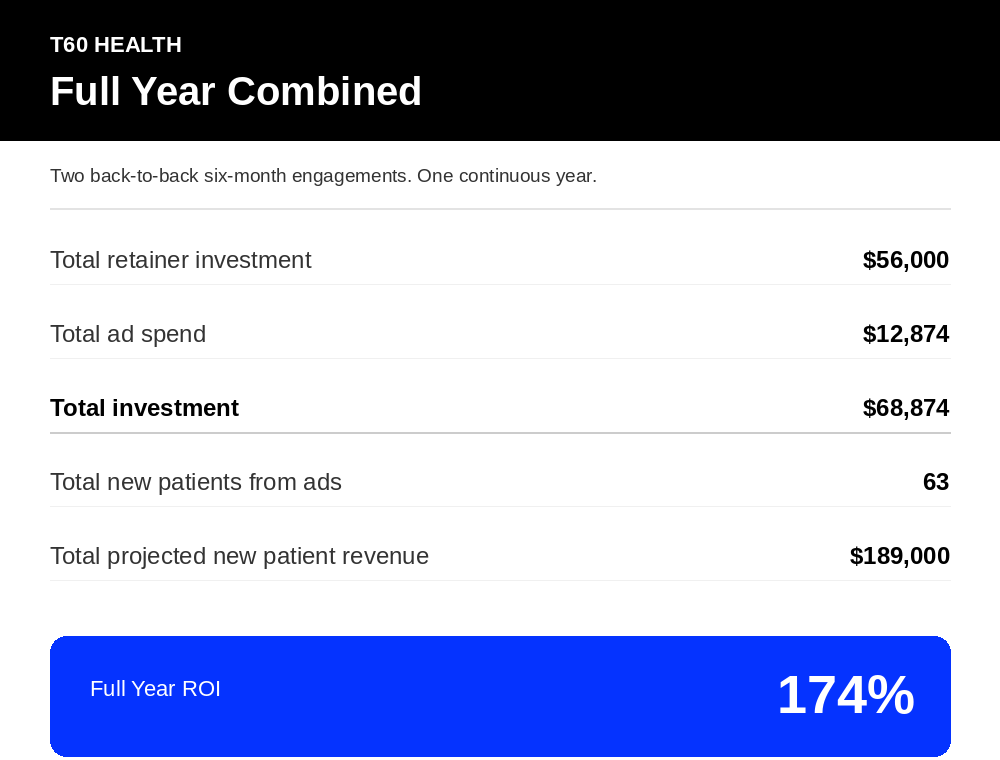
These numbers only count heel pain patients acquired through paid ads.
They don't include patients finding him through organic social, through the website, through the email campaign to existing patients, or through referrals those new patients generate.
That's what the math looks like at 12 months. And it's still only counting one patient type.
The Bigger Point
This wasn't complicated.
It wasn't expensive.
It didn't require a marketing department, an SEO audit, Google Ad Words, or Zocdoc.
It was four videos built around one specific patient's real questions, put in front of that patient where they were already looking.
That's the whole idea.
Start with the patient.
Figure out what's actually going on in their head… what they're afraid of, what they're Googling, what they need to hear before they'll trust someone enough to book.
Then build content around that. Then put it in front of them.
When the content is built around a real person's real questions, it doesn't feel like an ad. It feels like an answer.
And answers are what build trust.
This works because the content was built around one real patient's real question. The same ad spend behind generic content won't produce this.
Dr. Betschart didn't reinvent his practice. He just showed up… in the right place, with the right message, for the right patient. And the right patients found him.
That's what this looks like when it works.
We just increased Dr. Betschart's ad spend, with the rest of his retainer still ahead. We'll keep sharing what we learn as the numbers come in.